How to Choose the Best Forex CRM System for your Broker
11 Features in the Best Forex CRM Systems
A CRM tool is a key part of a forex broker’s business. Forex CRM software enables fx brokerages to offer clients excellent customer service and manage IBs and other partners. The best forex CRM system for brokers are more like a complete broker management system, including back office tools, partner portals, and a traders’ room and integrations.
We’re a little biased towards our own software, CurrentBusiness, but no matter what CRM you choose, make sure to ask about these features before you make a commitment. Keep reading to see why we think these features are so important and hopefully this article will help you choose the best Forex CRM for your business..
In this article we cover the broker operations from the Forex CRM perspective. Any system you used should incorporate both CRM and back office. To find out what you should look for in the best Forex back office please read here
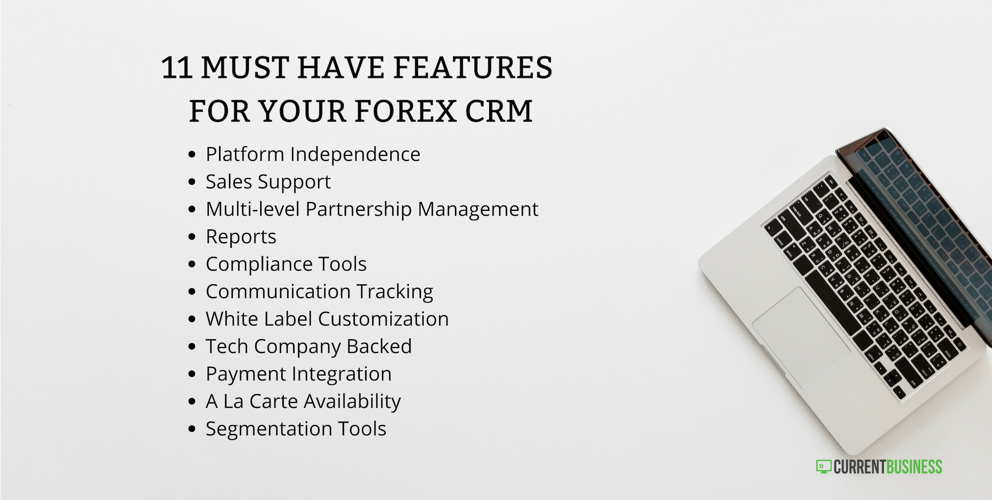
1. Platform Agnostic
As your business needs shift and you expand your business into new markets, you may wish to offer clients a different trading platform. However, that can cause software headaches if you are using a CRM or back office that is built into the trading platform
2. Sales support
Making it easy for sales agents and IBs to generate and nurture leads is a central part of any CRM. It should enable you to keep track of all a lead’s contact information as well as where they are in the sales funnel and how often they’ve been contacted. Ideally, the system should also allow you to track where the lead came from so that you can focus your marketing efforts on the most successful channels.
3. Multi-level partnership management
You need to be able to pay rebates to your introducing brokers and any other partners. If multiple partners are associated with the same clients, then you’ll need a tool that allows you to easily manage multi level rebates or payments so that the appropriate person is paid the correct amount. For that, look for Forex software that specifically mentions multi-level rebate management.
4. Reports
With all the data that will go into your CRM, it can be a powerful tool for compiling useful reports. It should be simple to generate reports on trading statistics, leads, revenue, dividends, regulatory requirements and much more.
5. Compliance tools
Technology that helps financial services companies address regulatory challenges, often called RegTech, should be built in to the best Forex CRM on the market. Look for software that allows you to manage KYCs and track whether or not clients have submitted the appropriate documents. Consider how you’d like a CRM to help with KYCs, and ask whether the toll is capable of that during a demo. If you want to have very fast on-boarding consider CRMs that are integrated with Auto KYC providers.
6. Communication tracking
A core part of any CRM should be its ability to improve your relationships with customers. You can do this by keeping detailed records of all communication with a client. CRMs can help you keep track of those records by providing a feature for storing notes and emailing clients. This ensures that whenever a trader talks to someone at your brokerage, the employee will be able to accurately speak to what’s happened with their account in the past.
7. White label customization
You want a consistent brand image and voice across your website, social media profiles, and your client portal. To achieve that consistency, look for a CRM that lets you customize the trader’s room with your own logo and color scheme. Then, when clients log in, they see the branding that is familiar to them, which makes your brokerage look more professional.
8. Software company
Choose a software company that specializes in CRM and back office software, rather than a company that provides liquidity and/or a trading platform and has the CRM or back office as a side product. A company that specializes in this industry will offer you more reliable tools and it doesn’t matter if they check every box on paper to be considered the best Forex CRM, once you start using the system you will find all the kinks that have been neglected.
Some companies that offer a CRM for Forex brokers are also either in the brokerage industry or own Forex brokers or are even owned by an FX Broekrage. This can be a significant conflict of interest. Be careful of this because you’ll be providing your client data to one of your competitor and doing so would be very detrimental to your business. Choose a provider that is solely a software or tech company. Changing CRM systems is difficult so think year ahead when choosing the best Forex CRM for your business.
9. Payment integration
You want to make it easy for traders to make deposits, because the easier it is, the more likely they are to make their first deposit and then keep trading. Choosing a Forex CRM & back office system that integrates with payment methods is one way to ensure deposits flow increases. When your CRM integrates with payment methods, like Skill, or Neteller, or payment gateways like Praxis payments are immediately processed.
Consider also whether the CRM has a secure flexible payment API. This will allow you to integrate to any PSP you choose in cases where a particular PSP is not included in the CRM’s PSP integration list and might take time to integrate to.
10. A la carte availability
Some CRM providers require you to use a variety of other services they provide, like web development services. Sometimes they require you to use a specific liquidity provider that pays the CRM for providing business. This might seem helpful if you’re just starting your business but later will it will lock you into the rates a single company sets, for example for liquidity. This limits your ability to adapt as your brokerage grows since they hold your data. Instead, look for a CRM provider that specializes in the CRM software and doesnt provide other products as part of their offering.
11. Segmentation tools
With many clients making multiple trades per day, you’ll likely be dealing with a large amount of data. Look for a CRM that makes it easy to manage that data. One way FX CRM tools do this is by letting you divide clients based on a wide variety of factors, like country of residence, annual income, or EMIR classification. This can help with client retention efforts, compliance management, and more.
Bonus - built in features that grow your business
Scalable pricing:
You dont want to pay a lot when you start your brokerage or when you have a week month. Therefore pricing based on the number of active traders is superior to a flat price which might become a burden. As a market leader we are confident out product will support your needs and we are sure that you will find it to be amongst the best Forex CRM system available.
MAM:
The best Forex CRMs on the market also provide a built in Multi Asset Management tool for asset managers so that they can trade on behalf of clients.
Client & Partner Portals:
The best Forex CRM system or your business wont only facilitate work for your employees, it will also enable you clients and partners.
In essence such a system should provide a CRM for your partners so that they can manage their business under your umbrella.
Clients should have a portal to log into, similar to online banking, in which they can execute transactions, run reports, and upload KYC documents, etc as needed.
Evaluating the best Forex CRM for your business is no small task. It requires understanding all aspects of your business now, and foreseeing what your needs will be years ahead when your business grows. We hope this article helps you choose the best Forex CRM system for your brokerage. Feel free to contact us if you have any questions!

Ron
Ron S.
Executive Director & FinTech Founder
FinTech strategist and McGill alum with a dual background in AI/Computer Science and Finance. With 18+ years of experience—from leading global trading desks to founding CurrentDesk—I specialize in bridging the gap between complex algorithmic systems and global capital markets to drive institutional growth.