7 Best Forex Back Office Software Systems for Brokers in 2026: Key Features and How to Choose
Running a successful Forex brokerage in 2026 demands more than just trading platforms – you need a robust Forex back office software system that automates the non-trading parts of your business. Modern Forex back office software solutions (often called Forex CRM + back office software) handle client onboarding, KYC/AML compliance, account and treasury management, IB/partner commissions, risk monitoring, reporting, and more.
Such a system connects to trading platforms (MT4/MT5/etc.), payment processors, KYC services, and support tools, giving your team one place to operate. By replacing spreadsheets and manual processes, Forex back office software reduces errors, speeds up operations, and frees your staff to focus on growth and client service.
Whether you’re a startup broker or a global firm, the right Forex back office software can drastically improve efficiency, client retention, and profitability. This guide reviews the 7 leading Forex back office systems today, highlighting each one’s strengths and noting any trade offs. We also outline the key features to look for and how to pick the best fit for your brokerage.
What Is a Forex Back Office System?
A Forex back office system is specialized Forex back office software that manages all post trade administrative operations of a brokerage. Unlike front end trading platforms that traders use, a back office deals with everything behind the scenes: account setup, KYC/AML document verification, fund deposits/withdrawals, balance transfers, bonus and rebate calculations, IB commissions, risk/rebate dashboards, and compliance reporting.
Essentially, it turns the manual, error prone tasks of a broker into automated workflows and real time dashboards using Forex back office software.
Modern solutions are typically cloud based and API driven, designed to scale across multiple asset classes (Forex, CFDs, crypto, etc.). They integrate with trading engines (MetaTrader, cTrader, proprietary systems), hundreds of payment gateways, KYC/AML services (SumSub, Idenfy, etc.), and even marketing tools.
The goal is to give the brokerage full visibility and control – instant P&L reports, real time exposure alerts, automated client onboarding, self service client and partner portals – all securely and auditably. In other words, the back office is your central business hub powered by Forex back office software, so you can focus on growing your business.
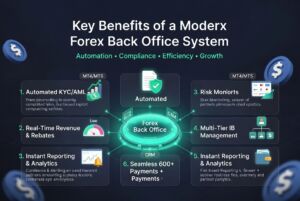
Key benefits include:
• Automated KYC/AML: Integrated verification and watchlist checks speed up onboarding while keeping records for audits.
• Account & Treasury: Real-time tracking of balances, multi-currency wallets, instant internal transfers and multi-asset support.
• IB/Partner Management: Multi tier commission trees, self service partner portals, and automated payouts.
• Risk & Reporting: Live exposure dashboards, margin alerts, plus instant P&L, rebate and compliance reports at the click of a button
.• Payment Processing: Hundreds of built-in PSPs (banks, e-wallets, crypto gateways) via secure APIs for fast localized deposits/withdrawals.
• Trader’s Room: Clients should have their own secure client portal similar to online banking where they can execute transactions and run reports.
With these in place, brokerages can scale quickly without being bogged down by paperwork or custom spreadsheet hacks. The right system will have most of these features out-of-the-box in a Forex back office software solution, plus tools like marketing automation and lead management to help you acquire clients.
Key Features to Look For
By 2026, a first-class Forex back office software should include:
• Platform Integrations: Plug-and-play with MT4/MT5 (and alternatives like cTrader, MatchTrader, White label platforms, etc.) via API.
• Payment & Wallets: Support for fiat and crypto, multi-currency accounts, and dozens of PSPs (local and global) out of the box.
• KYC/Onboarding: Built-in document collection, risk scoring, automated reminders, and third-party ID verification (SumSub, Idenfy, etc.).
• Partner Portals: Multi tier IB/affiliate management with real time commission calculations and self service partner dashboards.
• CRM & Sales Module: Lead capture, pipeline management, email/SMS modules, campaign tracking and sales analytics.
• Bonuses & Loyalty: Automated bonus/loyalty engine (promo codes, points systems) that drive engagement while preventing abuse.
• Reporting & Analytics: 20+ pre-built reports (P&L, spreads, fees, marketing ROI, compliance) and custom report builders.
• Compliance Tools: Audit logs, automated regulatory reports (MiFID II, FCA, ASIC, etc.), and built-in risk/fraud screening.
• Security & Certification: ISO 27001 (or SOC2) certified data security, with granular roles and 2FA for staff access.
• Scalable Pricing: Active-client pricing models (not per user) and transparent fee structures, with “startup-friendly” packages available.
1. CurrentDesk
CurrentDesk is a true all-in-one Forex brokerage platform and Forex back office software, combining CRM, back office, client portal, and IB management in one system. It’s purpose built for brokers, with a focus on being stable, fast, and turnkey. You get automated KYC (with reminders and SumSub integration), one day deployment for new brokers, and 600+ integrated payment providers via a built-in gateway (Praxis). Real time revenue tracking is fully automated – spreads, commissions, fees, swaps are computed live – and there are 25+ ready reports (P&L, risk, rebate, compliance, marketing analytics).
The partner module supports unlimited multi-tier IB trees and a bonus/loyalty engine, all tied into any trading platform (MT4/5, Shift Crypto Exchange, etc.) via API.
CurrentDesk is ISO 27001:2022 certified and designed to scale from startups to global brokers. Its key strengths are ease of use, flexibility, and support: they will even build custom integrations (PSPs, trading platforms) for clients upon request.
• Pros: Complete unified CRM + back office + portal; ultra-fast one-day setup; 600+ payment integrations (with open API for new ones); automated reports and multi-tier IB tools; ISO-certified security; custom feature requests handled quickly; very fast support; Offers very attractive packages for startups.
• Cons: The built-in employee/admin interface is highly functional but may seem less slick than the newest consumer UIs (it’s built for robustness over flashiness). Some very advanced custom workflows can incur one-time setup fees.
2. B2Core
It is particularly strong for brokers that want a unified ecosystem combining CRM, trading infrastructure, and crypto services. The system is deeply integrated with B2Broker’s liquidity and trading stack, which can be a major advantage for multi-asset operations. However, this depth also means it is more complex to configure than lighter Forex back office software options. It also means that if a broker wants to change back office provider it will be more difficult for them.
• Pros: Very strong multi-currency and crypto support (wallets, coins, digital asset pairs); deep IB and PAMM/MAM functionality; extensive ecosystem integration (B2Broker liquidity, payment stack); proven stability for large brokerages.
• Cons: Enterprise-class cost and complexity; longer implementation timeline vs. lightweight platforms; pricing tends to be on the high side (more suitable for established or rapidly scaling firms); Harder to change provider.
3. FXBO
FXBO is often selected by brokers that need long-term operational scalability and a highly customizable structure. Its large integration ecosystem makes it suitable for complex brokerage setups involving multiple PSPs and trading platforms. Some advanced configurations may require technical onboarding due to the system’s depth.
• Pros: Extremely flexible and scalable; supports 320+ integrations with payment gateways, platforms, KYC, etc. (over 340 PSPs worldwide); ISO27001 certified for security; highly granular commission and workflow settings; single unified client portal.
• Cons: Longer deployment and learning curve to configure all options; UI can feel somewhat dated in parts (built for function); total cost of ownership can be higher as advanced modules add up.
4. UpTrader
UpTrader is particularly effective for brokers that prioritize fast client acquisition and marketing-driven growth. It combines CRM and back office functionality in a way that supports sales funnels and conversion tracking very well. Compared to heavier Forex back office software systems, it is quicker to deploy and easier to manage.
• Pros: User-friendly, mobile friendly interface; strong sales/lead management and communication tools; built-in social/copy trading (UpTrader Invest); typically rapid deployment; cloud-based with good uptime.
• Cons: The base CRM covers essentials, but some brokers find they need to purchase extra modules (e.g. advanced PAMM, multi-brand white-label) to match large broker needs. IB tiers are limited on lower plans, and API access is not as open as some newer platforms (custom API work may require more support).
5. DXtrade / dxFina
This solution is primarily aimed at institutional brokers and firms with advanced trading requirements. It delivers strong execution performance and real-time risk management capabilities across multiple asset classes. Because of its complexity, implementation usually involves close collaboration with the vendor’s technical teams.
• Pros: Enterprise-level performance and risk management; real-time position and exposure tracking with instant margin controls; fully customizable trading/back-office workflows; built-in dealer desk and data feeds.
• Cons: Higher total cost and technical complexity; steeper learning curve for staff; more suited to large or multi-asset brokerages (may be overkill for small startups).
6. Panda Trading Systems
Panda CRM is built for brokers that need automation across the entire operational workflow. It is particularly effective in high-volume environments where manual processing would not scale efficiently. Setup can be detailed, but once configured it significantly reduces operational workload.
• Pros: Deep automation (automated workflows for onboarding, account setup, KYC, etc.); strong PAMM/MAM/social trading support; comprehensive IB/affiliate program; handles very large client counts without slowing down; everything from CRM to back office in one package.
• Cons: Being very feature-rich, the UI can sometimes feel busy. A few users report occasional performance tweaks needed under peak load or during rapid growth. Also, as a private company, Panda has a smaller public track record than some legacy vendors (though it powers many brokers quietly in the background).
7. Brokeret
Brokeret is designed for brokers that want a modern and lightweight approach to brokerage infrastructure. It focuses on fast deployment and ease of use while still covering core back office functions. It is often chosen by startups that want to avoid the complexity of enterprise systems.
• Pros: Modern, intuitive UI; full API access and unlimited IB tiers; quick implementation; built-in compliance module (24/7 KYC/AML) and broad payment integrations. Unlimited multi-level partner structures and all core tools included without expensive add-ons.
• Cons: As a younger company, Brokeret has fewer long-term live broker case studies; some very large, legacy brokers may require more customization than its standard offering.
How to Choose the Right Back Office
Scale & Budget: Startups often prefer fast Forex back office software like Brokeret or UpTrader. Larger firms choose FXBO or B2Core.
Platform & Ecosystem: Ensure compatibility with MT4/MT5, PSPs, and KYC systems.
Features vs Usability: Some Forex back office software tools are highly advanced, others focus on simplicity.
Security & Compliance: Look for ISO/SOC2 certification and audit readiness.
Pricing Model: Prefer transparent active-user or usage-based pricing.
Support & Roadmap: Strong vendor support is critical.
How to Choose the Right Forex Back Office Software
Scale & Budget:
For a startup or boutique broker, fast deployment and client-based pricing are critical; systems like CurrentDesk, Brokeret or UpTrader often fit well. Mid-to-large brokers will value deep customization and multi-brand support (B2Core, FXBO, Panda).
Platform & Ecosystem:
Ensure the solution natively supports your trading platforms (MT4/5, any proprietary or mobile platform) and payment channels. If you trade crypto or operate multiple asset classes, favor platforms built for that (B2Core, Devexperts).
Features vs. Usability:
Look for a balance – some systems (like Panda or FXBO) offer very granular features, while others (Brokeret, UpTrader) prioritize ease of use. Consider what your team can maintain without constant development help.
Security & Compliance:
Check that the Forex back office software provider has ISO 27001 or SOC2 certifications and audit-ready reporting. If you operate in strict jurisdictions, make sure the provider supports those specific regs.
Pricing Model:
Prefer transparent pricing (often based on active accounts or features used). Beware of hidden module costs – many CRMs have a “base fee + add-on” model. Ask about startup or trial packages to test performance under load.
Support & Roadmap:
Rapid feature updates and responsive support can be a huge advantage. Ask about SLAs and how feature requests are handled.
Trial & References:
Always demo with your real data (or realistic sandboxes) and get references from similar brokers.
Final Thoughts
In summary, each Forex back office software platform above has proven itself in the industry. CurrentDesk stands out as an all-in-one solution with rapid deployment and full-stack automation. B2Core is unmatched in multi-asset and crypto support. FXBO excels for extensive integrations and enterprise scaling. UpTrader is a flexible, user-friendly choice for growing brokers. Devexperts (DXtrade/dxFina) offers an ultra‑high performance integrated platform for large firms. Panda CRM automates almost every brokerage function for high-volume operations. And Brokeret delivers a modern, cost-competitive package ideal for fast launches. Evaluate each against your priorities (deployment speed, pricing, features, integrations, support) to pick the best fit.